What our Weavers Love Most about Being at the Loom
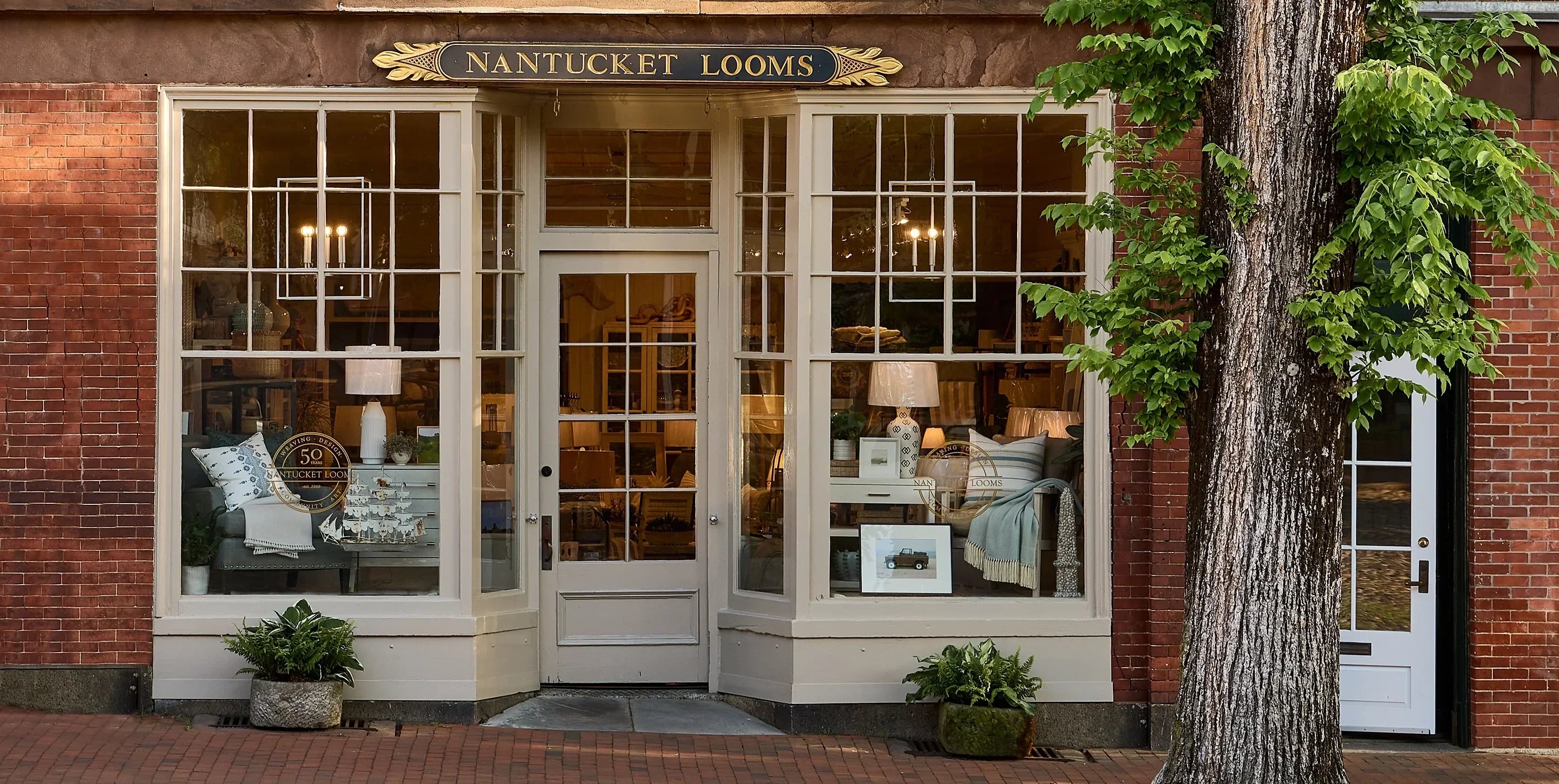
If you step into the second floor weaving studio at Nantucket Looms, the first thing you notice is that everything in the room is in motion.
The day's work has begun long before customers walk through our front door and climb the stairs to the studio. Looms are being threaded and dressed, yarn is wound, and the steady click and clack of shuttles passing through warp threads has taken on its familiar role as the soundtrack of the room. This is where mohair, alpaca, cashmere and cotton are woven into blankets, scarves, wraps, dish towels and more. Since we know that weaving requires a certain level of passion for creativity, this Valentine's Day, we asked our weavers a simple question: What do you love most about weaving?
What we learned wasn't that it was one answer but rather a deep emotional connection to their craft.

Inside the Studio
The weaving studio has its own cadence. Each stage of the process brings a different experience. Some moments demand intense focus — counting threads to ensure precise measurements. Others engage the senses more subtly: the soft mechanical chorus of pedals and heddles working together to build a pattern or the warmth of an iron releasing steam as the natural fibers are smoothed over. Every sensory detail is in play at once.
"The all-around sensory experience of weaving is magical," says Heather. "The sound of the loom, the textures and colors of the yarns, the scents the studio itself with all the different fibers— it's all part of it."
For someone unfamiliar with weaving, it's easy to imagine it as purely technical. But time spent in the studio makes it clear that weaving is both a physical and mental artform. Attention sharpens. Intuition takes over.
"I love working with my hands — or really, watching my hands work," Heather adds. With experience comes muscle memory: movements repeated so often they become instinctive. "The more I weave, the more my hands seem to know what to do before I think about it."

From Thread to Cloth
Every piece begins the same way — with yarn. Measured, tensioned, and carefully set on the loom, threads are prepared long before weaving begins. From there, the structure takes shape slowly. Color, pattern, and weight reveal themselves through repetition, one pass at a time.
For Lori, the satisfaction lies in that full arc of the project; seeing a piece move from the raw materials to becoming a purposeful and beautiful final product.
"As both a knitter and a weaver I've always loved the discipline of seeing a project from start to finish," she says. "Although the processes are different, it requires the same commitment to create a product that you are proud of."
What keeps the work engaging, she explains, is the opportunity to experiment within that structure. "The actual weaving is especially gratifying," Lori adds, "particularly when trying new weave structures or color combinations." That curiosity and constant learning is a constant part of the work at the loom.
For Chris, the satisfaction is what happens when the process is complete.
"What I love about weaving is the transformation," says Chris. "You start with yarn — just one long thread — and turn it into fabric with structure and purpose. You're taking raw material and turning it into something people will use and live with," Chris says. "Something that brings joy."


Rhythm and Balance
For some weavers, the loom offers something beyond craft. It provides balance. "Weaving is my life," says Gergana. For her, the work is rooted in the steady repetition that calms the mind and brings focus. Returning to the same motions again and again creates a sense of order, and with it, a deep satisfaction in seeing a piece through from beginning to end.
That routine extends beyond the studio. As a wife and mother, Gergana sees weaving as a reflection of her own life — a way to hold balance between work, family, and self.
"It represents my life," she says. "Through this job, I can find rhythm between my busy life at home and my work at the loom."
Each piece becomes personal. The emotions she brings with her are worked into the fabric itself. "Every piece that I create tells a story," she explains. "It reflects my passion for creating works of art that I know will be enjoyed for years to come. It is extremely personal for me."
At its core, weaving is simple: threads brought together, one pass of the shuttle at a time. But through care and intention, those threads become something meaningful, something whole. "I think of myself as one of the threads that completes the Nantucket Looms family," Gergana says. And like the cloth she creates, her work is both individual and inseparable from the larger story.


Sense of Place
For Head Weaver Becky that sense of discovery remains central to the work.
"Weaving is a balance between intention and surprise," she says. "You can plan carefully, but the process can require a change in direction, troubleshooting along the way. Working on Nantucket adds another layer of meaning. Here on the island, every piece carries a sense of place," she says, "shaped not only by materials and technique, but also a reflection of the colors and history that surround us."
At Nantucket Looms, weaving is not a single moment of inspiration, but a sequence of thoughtful steps guided by experience, repetition, and care. It's a practice rooted in traditions that have passed on for the past 57 years from one weaver to the next. And it is this love of heritage craftsmanship that keeps us sharing our artistry beyond the shores of Nantucket.